Monday, August 28, 2006

4GW AND THE KURDISH CAUSE

“When I was a young officer, I was taught that if you have air superiority, land superiority and sea superiority, you win. Well, in Vietnam we had air superiority, land superiority and sea superiority, but we lost. So I realized there is something more to it.”
~ Col. John Boyd, USAF.


There have been reports in the last few days of Turkish F-16's bombing South Kurdistan, while, Iran continues to use artillery against unarmed Kurdish civilians in South Kurdistan. All of this is allegedly an attempt to knock out the PKK. Unfortunately for these two Islamist states, air power and artillery never managed to hold terrain; the only thing that can hold terrain is infantry.

From the Draft Manual on 4GW War:


America's greatest military theorist, Air Force Colonel John Boyd, used to say:

“When I was a young officer, I was taught that if you have air superiority, land superiority and sea superiority, you win. Well, in Vietnam we had air superiority, land superiority and sea superiority, but we lost. So I realized there is something more to it.”


There's a hell of a lot more to it, as mentioned a later in the same reference:


At the heart of this phenomenon, Fourth Generation war is not a military but a political, social and moral revolution: a crisis of legitimacy of the state. All over the world, citizens of states are transferring their primary allegiance away from the state to other things: to tribes, ethnic groups, religions, gangs, ideologies and so on. Many people who will no longer fight for their state will fight for their new primary loyalty. In America’s two wars with Iraq, the Iraqi state armed forces showed little fight, but Iraqi insurgents whose loyalties are to non‑state elements are now waging a hard‑fought and effective guerilla war.

The fact that the root of Fourth Generation war is a political, social and moral phenomenon, the decline of the state, means that there can be no purely military solution to Fourth Generation threats. Military force is incapable, by itself, of restoring legitimacy to a state. This is especially the case when the military force is foreign; usually, its mere presence will further undermine the legitimacy of the state it is attempting to support. At the same time, Marines will be tasked with fighting Fourth Generation wars. This is not just a problem, it is a dilemma– one of several dilemmas Marines will face in the Fourth Generation.


and:


While the classical three levels of war carry over into the Fourth Generation, they are joined there by three new levels which may be more important. Colonel Boyd identified these three new levels as the physical, the mental and the moral. Further, he argued that the physical level – killing people and breaking things – is the least powerful, the moral level is the most powerful and the mental level lies between the other two. Colonel Boyd argued that this is especially true in guerilla warfare, which is more closely related to Fourth Generation war than is formal warfare between state militaries. The history of guerilla warfare, from the Spanish guerilla war against Napoleon through Israel’s experience in southern Lebanon, supports Colonel Boyd’s observation.

This leads to the central dilemma of Fourth Generation war: what works for you on the physical (and sometimes mental) level often works against you at the moral level. It is therefore very easy in a Fourth Generation conflict to win all the tactical engagements yet lose the war. To the degree you win at the physical level by pouring on firepower that causes casualties and property damage to the local population, every physical victory may move you closer to moral defeat. And the moral level is decisive.


Correct. The moral level is decisive and this is why Turkey, Iran, the US, and the West generally, ignores the atrocities inflicted on the Kurds of Turkish-occupied Kurdistan while trumpeting the atrocities inflicted on Bashurî Kurds--as we see now in the trial of Saddam's Anfal atrocities. The US is also beginning to trumpet the atrocities inflicted on the Rojhelatî Kurds. This sudden concern for Bashurî and Rojhelatî has less to do with actual concern for Kurds per se, and much more to do with the US attempting to justify American policies, thereby creating a perception of success on the "decisive moral level."

We know this because no American administration has ever made a public condemnation of Turkish atrocities against the Kurdish people and attempts to control the massive flow of weapons to Turkey have always ended "not with a bang, but a whimper."

On the other hand, PKK has adapted itself to the political environment over the decades of its existence and continues to enjoy support from its own population. As a result of the Semdinli bombing last November, the suspicions of the use of chemical weapons against Kurds by the fascist Ankara regime in late winter, and the brutality meted out to Kurds during the Amed Serhildan in late March, PKK's popularity continues to soar.

In other words, the brutality of the Ankara regime, and the silence of the world in the face of it, coupled with Kurdish and PKK will to resist, ensures that support for PKK is either maintained or increases. The same can be said for PJAK, especially after the world's silence during the serhildan last August, as well as in continued extraditions of Kurdish political prisoners between the two Islamist states (Turkey and Iran), and the continued executions of Kurdish political prisoners by the Teheran regime.

With the PKK's adoption of 4th generation warfare methods to augment their traditional gerîla structure, the need for infantry--ultra-light infantry in particular--to hold terrain that appears to be under PKK control, becomes even greater. More from the 4GW draft manual:


As a practical matter, the forces of most of our non-state, Fourth Generation adversaries will be all or mostly irregular light infantry. Few Fourth Generation non-state actors can afford anything else, and irregulars do enjoy some important advantages over conventional forces. They can be difficult to target, especially with air power and artillery. They can avoid stronger but more heavily equipped opponents by using concealment and dispersal (often within the civil population). They can fight an endless war of mines and ambushes. Because irregulars operate within the population and are usually drawn from it, they can solicit popular support or, if unsuccessful, compel popular submission.

Light infantry is the best counter to irregulars because it offers three critical capabilities. First, good light infantry (unless badly outnumbered) can usually defeat almost any force of irregulars it is likely to meet. It can do this in a “man to man” fight that avoids the “Goliath” image. If the light infantry does not load itself too heavily with arms and equipment, it can enjoy the same mobility as the irregulars (enhanced, as necessary by helicopters or attached motor vehicles).

Second, when it uses force, light infantry can be far more discriminating than other combat arms and better avoid collateral damage. This is critically important at both the mental and moral levels.


There are a couple of keys to the employment of light infantry against PKK. The first is the terrain of Kurdistan. It is extremely mountainous and is closed off to all but the heartiest during winter, when it becomes especially treacherous due to avalanches. Secondly, PKK knows the terrain intimately and can blend in perfectly with the local population at a moment's notice. In order to reach any kind of success, occupying forces must lighten their equipment loads to the same level as a gerîla, in order to keep up with gerîlas. They must engage in unfamiliar, treacherous terrain and, unless they are prepared to overwinter in the harsh mountain climate like gerîlas, they can only attempt to engage gerîlas during half of the year.

The last fact is that no potential occupation force has the love of the Kurdish people and Kurdistan that is necessary to sustain them for the long term in such harsh conditions. In short, unlike the PKK gerîla, no occupiers have an intangible "strategic center[s] of gravity" to sustain the will to fight. This is why they use F-16s and artillery to murder Kurdish civilians now, putting themselves squarely in the middle of one of the "dilemmas that typify Fourth Generation war:" the use of F-16's and artillery accomplishes nothing but the creation of fear and loathing in the Kurdish population, which is already a defeat for the occupiers.

From May, 2005:


The HPG officials said that the TAF has been unsuccessful in its operations and that the HPG’s new way of actions on the basis of small groups of guerrillas with active and high action capacity led to TAF’s classical operation tactic to be in vain.

HPG officials said that as a result of this new way of action, TAF (Turkish Army Forces) had difficulties in “imposing clashes on the guerrilla under its initiative” and that the TAF military troops have become an open target for the guerrilla teams who have spread well into the territory.

[ . . . ]

HPG officials said that this was “a reflection of the strategic changes made” and that the military strategy changed accordingly”. They underlined that “actions undertaken were no longer to establish free areas” but “to force the other side to a resolution”.

They also added that guerrilla losses, as a result, decreased in comparison with past years, but the TAF’s losses increased due to a change in guerrilla movement.


HPG did not remain idle during the five-year unilateral ceasefire. In addition to the establishment of HPG Special Forces and the adoption of MOUT-style training, HPG has also decentralized its command structure, giving more autonomy to team commanders to encourage individual commander initiative and freedom of operation within the framework set forth by HPG's mission objectives and rules of engagement. Teams are smaller, lighter, faster moving, work independently, and engage targets of opportunity at will.

After the PKK statement this last week, the criteria for the beginning of a bilateral ceasefire leading to a political settlement is out in the open. Failure to act on those criteria will extend the "political, social and moral revolution" of the Kurdish people, thereby extending the "crisis of state legitimacy," of the Islamist regimes in both Ankara and Teheran.

SERKEFTIN!

Sunday, August 27, 2006

THE RESPONSE

"Those who come seeking peace without a treaty are plotting."
~ Sun Tzu.


Lazy journalists have characterized Koma Komalên Kurdistan's recent statement as a cease fire offer. Of course, it's the same lazy journalists, along with their comrades, Turkish propagandists, who continue to refer to KKK as PKK. In a concession to extreme ignorance, let's talk about this.

All of it should sound familiar, if you're up on old KADEK and KONGRA-GEL statements.

First of all, let's reference the statement as published on DozaMe. The statement clearly indicates that some preliminary steps must be taken before there can be discussion of any ceasefire. Those steps are as follows:


1. The Ankara regime "must issue a statement to show the will for dialogue and solution,"

2. The Ankara regime must "cease its attacks,"

3. The Ankara regime must "end the heavy isolation conditions on our Leadership,"


When these conditions are met, KKK will immediately begin ceasefire operations. Given the history of all the past unilateral ceasefires with their calls for the negotiation of a political settlement, it is common sense that tells us there can be nothing more done unilaterally. Unilateral ceasefires have only meant sacrifice for the Kurdish side, sacrifices that no one is prepared to make any more, with no one on the other side of the table with which to discuss. At the same time, the statement indicates the continued willingness of Kurds to negotiate a peaceful settlement and search for a political solution to the suffering of the Kurdish people.

With the examples of the IRA and ETA, and the respective governments involved, Turkey's hypocrisy is now in the open. Given the recent call for an abandonment of legitimate self-defense on the part of Kurds by the US State Department, American hypocrisy is also now in the open, with the use of American aircraft against Kurdish civilians punctuating that hypocrisy like a row of exclamation points. EU hypocrisy is also displayed for the world to see in the references to the will of the Kurdish people as symbolized by this year's Newroz celebrations and by the Amed Serhildan, and all the remarks on that fact remind us of Cemil Bayik's responses to interview questions a few months ago:


We expect Lagendijk and the EU to respect the choice and the will of the Kurdish people. On 15 February (the anniversary of the abduction of Ocalan), 8 March (International Women's Day) and during Newroz people demonstrated their support for the PKK and Ocalan by chanting "PKK is the people". The Kurds carried posters of Ocalan everywhere and stated that Ocalan is the representative of their political will. Mr Lagendijk who talks about democracy does not recognize that and insists to the people that "Ocalan does not represent you". I do not think that this attitude reflects a commitment to democracy.


Speaking of democracy and the will of the people, it's clear from the statement that it is unacceptable to engage in a "trilateral discussion" of the Kurdish situation in Turkish-occupied Kurdistan by Turkey, the US and Iraq. Nowhere, in those three entities, is the will of the people of Turkish-occupied Kurdistan represented. Without the representation of the Bakûrî Kurds, nothing will be accomplished. The best that the US or Iraq can do is act as mediators to bring Turkey to a position of negotiation with the Bakûrî.

In this, there has been one voice in Kurdistan Bashûr that has consistently spoken of justice for the Bakûrî Kurds, from the Kurdish Globe:


Mahmoud Othman, Kurdistan Alliance member of the Iraqi National Assembly, said that the decision of the government to close PKK headquarters in Iraq is wrong, a local media reported.

“Turkey does not recognize the right of 20 million Kurds in Turkish Kurdistan and that is why it is unacceptable that we should close PKK headquarters on the request of the Turkish government,” Othman insisted.

[ . . . ]

Othman called on Kurdish officials not to support the Iraqi government’s decision regarding PKK.


If the Ankara regime meets the steps leading to a bilateral ceasefire, KKK has listed six items as being first on the table:


1- The acknowledgement of the Kurdish identity and the constitutional guarantee of all identities under the identity of a Citizen of Turkey as the main identity,

2- The lifting of obstacles on the development of the Kurdish language and culture, the acknowledgement of education in the mother tongue and Kurdish acknowledged as the official second language alongside Turkish in the Kurdistan region, and with this to show respect to other minority cultures,

3- The acknowledgement, on the basis of freely practicing politics and organizing, of the right to thought, belief and freedom of expression, the lifting of all social inequalities in the constitution and laws, firstly being those of gender discrimination,

4- A social reconciliation project with the aim of mutual forgiveness of both people’s for the development of a peace and freedom union, on this basis the release of political prisoners including the PKK Leadership, and no obstacles to them participating in politics and social life,

5- The removal of forces in Kurdistan there for the purposes of special war, the abolition of the village guard system and the necessary social and political projects to be developed for the return of displaced villagers,

6- In parallel to the realization of the above articles, the initiation, with a timetable determined by both parties, of the gradual disarmament and legal participation into the democratic social life.


Not much is new here and almost everything has been at least given lip service by the EU. However, the idea of a "social reconciliation project" is something that has not been officially called for by anyone else, although it will be absolutely necessary in order to create a democracy. It should be similar to truth and justice commissions that have been used in other countries to put abusive and violent histories in the past. In the case of the Ankara regime, the risk will be that Turkish atrocities against the Kurdish people will go the way of the Armenian Genocide--into the black hole of denial--unless such a commission is established.

The second item is the proposal of the establishment of a timetable by both parties for disarmament as well as "legal participation into the democratic and social life," which I take to mean the integration of gerîlas back into civilian life, along with all leadership, as well as the full acceptance of DTP.

Given the barbarity of the Ankara regime with its "chauvenistic outlook," and the fact that it "has no other policy besides denial and annihilation," there is little hope that it will deviate from its usual behavior regarding the situation of Kurds under occupation for the simple fact that it only sees "everything in terms of force in arms and violence."

Ultimately, then, what is the point of this statement? Since we know that, at this point, Turkey is incapable of accepting any Kurdish demands, then we know this statemen is a reply to the recent US State Department call to PKK. On 15 Tebax, the US called on PKK to lay down arms and end it's legitimate defense against America's terrorist ally. It is also a reply to the Iraqi Government in its recent attempts to placate both the American and Turkish governments, over the will of the Kurdish people.

Ball's in your court now, America.

Tuesday, August 22, 2006

BURNING DOWN THE HOUSE

Watch out
You might get what you're after
Cool babies
Strange but not a stranger
I'm an ordinary guy
Burning down the house
~ Talking Heads, Burning Down the House.


Since June of this year, forest fires, set by Turkish security forces, have been burning in Turkish-occupied Kurdistan and a number of trees have been cut down for "security" reasons, as reported by Bianet. The fire from that report was started on Şirnêx's Cudî Mountain. In mid-August, Turkish security forces started another forest fire in Çewlik (Bingol) province. Again, the cutting down of trees was linked to the fires.

Lately, too, there has been a lot of news in the Turkish media about forest fires in Turkey proper. An article today from TDN gives some fairly good coverage of how busy Turkish forestry officials and firefighters have been in trying to maintain control over so many blazes, including efforts to evacuate panicked tourists from a shrine in Ephesus. Fires appear to be starting in a number of provinces, including Aydin, Izmir, Antalya, Duzce, Sakarya, Adana, and Konya.

The concern is that with higher temperatures and lower humidity, conditions become even more favorable for wildfires, from the TDN article:


Ünal said recent rainfall in Central Anatolia has somewhat decreased the risk of forest fire. The rainfall has brought up the humidity level to 50 percent from 20 percent. The risk of forest fires [significantly] increases when the humidity level falls below 25 percent and poses a more serious threat as humidity continues to fall. It's been announced that this week will see a new heat wave. This is of great concern to us, because the humidity level will fall below 20 percent, bringing the potential risk of forest fire to a maximum.


Ali Fuat Unal, the forestry official from Konya, reassures us that "firefighters in the area were alert and prepared for action at any time, with all training and leave canceled." According to Unal, even ordinary citizens have an extremely important role to play in the prevention of wildfires because with the upcoming weather conditions, "even the most miniscule spark" contains the potential to unleash a veritable conflagration.

The TDN article also brings us some important information from the Turkish Minister of Environment and Forestry, Osman Pepe:


Pepe said that carelessness was the principal cause of forest fires and that 95 percent of were caused by careless picnickers or villagers burning dried wood. The best method of fighting forest fires is prevention, he advised.


Uh, yeah, it's carelessness. Imagine the utter carelessness of those who destroy the forests! Imagine the utter carelessness of those Turkish security forces who destroy Kurdistan's forests! Wise words indeed! People should be more careful. Our Osman Pepe is a regular Turkish version of America's Smokey the Bear.

The Gulen Gang's ragsheet, Zaman, has something on the fires as well:


Turkey continues to burn as 19 of 23 forest fires raging around the country had been brought under control by Tuesday morning, while fires continue to rage near the town of Kas and Milas despite a massive firefighting effort.

Nearly 600 hectares of forest has been destroyed by the fire which started yesterday and was fanned by strong winds near the town of Milas in southwestern Turkey.

Some 500 firefighters backed by helicopters and firefighting vehicles are struggling to bring the fire under control.

The fire is moving toward residential areas and houses in the region were evacuated as a precautionary measure.


Isn't that too bad? Even residential areas are threatened, and all due to carelessness. Or, maybe not:


The illegal Kurdistan Workers Party (PKK) has claimed responsibility for the current wave of forest fires across Turkey. A pro-PKK website has reported that the terror organization has claimed responsibility for the fires.


Unfortunately, the Islamists at Zaman are not too accurate about whom is responsible for Turkey's sudden rash of fires. There is no statement on any PKK website. However, one can find a claim of responsibility on TAK's website. TAK claims fires in the following regions: Istanbul, Antalya, Bodrum, Mugla, İzmir, Cankiri, Kastamonu, Karaman, Balikesir, Bolu, Amasya, Sakarya, Denizli, Karabuk, Manisa, Canakkale, Aydin.

As the fires in Kurdistan are not a result of carelessness, neither are the fires in Turkey the result of carelessness. TAK's operations are direct retaliations for the fascist Ankara regime's destruction of Kurdistan's forests. It should be very clear, then, what the price for carelessness will be, and what the only prevention is.

Remember, Turkey, only YOU can prevent forest fires.

In other hot news, Persian Journal has a little mention of HPG's spectacular Saturday-night fireworks display near Agri:


PKK Claims Saturday's Gas Pipeline Explosion in Agri

The PKK has also claimed responsibility for Saturday's explosion which hit a natural gas pipeline in the eastern Turkish province of Agri.

The pro-PKK Firat News Agency reported on Sunday that the PKK terrorist organization had claimed responsibility for the attack on the pipeline.

Late on Saturday, a major explosion had hit the natural gas transfer unit of the Turkish Natural Gas Pipeline Company (BOTAS), which carries natural gas from Iran to Turkey, near the village of Gecitalan. Firefighters fought for four hours to bring the fire that broke out following the blast under control. The sabotage came after the Iranian-Turkish gas aggreement. Some argues that the PKK attack targeted the Iranian-Turkish co-operation, not only the pipelines.


I'm so glad they got the message.

Saddam's trial over the chemical attacks against Kurds during the Anfal campaign is ongoing, and I came across some garbage on that subject. If you think Americans are bad, check out this freak in the UK, from the Daily Mail. Just take a look at it and you'll see what I mean.

The fact that the freak who wrote the Daily Mail article refers to Anfal as "alleged," should tell you a lot. The fact that the freak refers to Saddam Hussein as having a law degree from Cairo University, and therefore knows more about law than anyone else would normally have us all rolling on the floor in laughter, tears streaming down our faces, if the juxtaposition of Saddam's law degree with photos of the Helebçe dead didn't infuriate and disgust instead.

The best, and most telling line, has to be this one:


Of course, Saddam was a violent dictator, but every government in that region is some sort of dictatorship.


Shut up, Kurds! Everybody has a dictator. Get over it. But ask yourself this: If it wasn't a bunch of white boys like the freak author of the Daily Mail article who created the modern Middle East, with all its dictators, then who was it? I think the author is suffering from a severe case of "White Man's Burden."

In contrast, old Kurdish guys can be so cool. Check this out, from the AP, carried on Kurdish Aspect:


At Beshenki, some 50 kilometers (about 30 miles) northeast of Dohuk, the head of the village has made sure that the community generator was working.

"I don't want to miss a moment of this trial. I've waited for it forever," said Mohammed Hussein Suleiman, at 72 years one of the elders of this village of around 100 inhabitants.

"This trial is too merciful for him. The coalition are going to leave him his life but he should be dead. He does not merit still to be living.

"If you brought him here, you would see the sort of trial that we would give him," said Suleiman.


Oh, Suleiman, you go boyfriend! That's what I'm talking about, and it got me thinking: How hot would it be if pêşmerge stormed the court, whisked Saddam away to a secure, undisclosed location in South Kurdistan, and someone like Suleiman and company could arrange their own trial?

Saddam's lost a lot of weight while in prison, though. We'd have to fatten him up before turning him into fishbait . . . but just so that there'd be more of him to kill.

Sunday, August 20, 2006

A WARNING FROM THE KURDS

"Turkey aims to defeat the Kurds through military aggression, isolation and repression against our movement. We have no other option but to resist such attacks. Resistance is our legitimate right. Resistance is a right enshrined under international law. As long as the Kurdish Question remains unresolved we will resort to our legitimate right to resistance. We will not accept surrender or death."
~ Cemil Bayik.


Kurdish gerîlas of the HPG sent a fiery warning to the fascist regimes in both Ankara and Teheran, late Saturday night, by conducting a successful operation against a natual gas pipeline near Agri. More from the Washington Post:


ANKARA, Turkey -- A suspected Kurdish rebel attack caused an explosion and huge fire on a natural gas pipeline in eastern Turkey, the Energy Ministry said.

The region's governor, Halil Ibrahim Akpinar, said separatist Kurds were suspected of carrying out an attack on the pipeline. He did not say if a bomb was believed to have caused the explosion.

The blast shook houses in nearby villages, the private Dogan news agency reported.

Gas flows to the nearby province of Erzincan were cut, Energy Ministry spokesman Bulent Ismen said.

Paramilitary police sealed off the area and firefighting teams were dispatched to the region.

Turkey has been importing natural gas from Iran through the 1,598-mile pipeline since 2001. Turkish and Iranian officials are reportedly discussing expanding the pipeline for exports to Europe.

Rebels of the Kurdistan Workers' Party, or PKK, previously have sabotaged pipelines as part of their struggle for an autonomous homeland in southeastern Turkey. More than 37,000 people have been killed since the rebels took up arms in 1984.

The group is considered a terrorist organization by Turkey, the United States and the European Union. Turkey is pressing the United States and Iraq to crack down on the rebels, many of whom are based in northern Iraq.


ANF reports that the blast was felt up to 40 kilometers away and a devastating fire was produced by the explosion. Flames from the blaze were seen in Kars and Igdir. The HPG operation against the Turkish and Iranian regimes is a warning to them in response to their recent joint military operations in the region, confirmed an HPG-BIM statement.

More news is available at Reuters and CNN.

As Murat Karayilan said in May, if Turkey or Iran attack any Kurdish factions, guerrilla war will be the result. From the Scotsman:


"If Iran and Turkey continue attacking the bases of the PKK or other Kurdish factions, the PKK will launch a guerrilla war against Turkey because the PKK has forces in Turkish areas," Murat Karayilan, a PKK leader, told a news conference.


Now, if anyone thinks this operation was launched from Qandîl, go find a map and locate all the places mentioned so far. Compare them in relation to Qandîl. The fact is that HPG and PJAK are among the populations of Turkish- and Iranian-occupied Kurdistan.

Turkey and Iran have recently agreed to a joint venture to export Iranian natural gas to Europe via Turkey's pipelines, from MehrNews.com:


TEHRAN, Aug. 18 (MNA) – The Islamic Republic of Iran is to export natural gas to Europe via neighboring Turkey, said the oil minister upon his return from Ankara late at night on Wednesday.

This, however, is not going to take place through construction of a new pipeline to deliver gas to Europe. The current Iran-Turkey gas pipeline would be a good option to this end. Both sides have decided to consider the issue in the next round of talks in Tehran, Kazem Vaziri-Hamaneh added.

"During this visit, Iran's gas export projects through Turkey were clarified and will soon be finalized," PIN quoted the minister as saying on Friday.

"It was planned to increase the capacity of Iran's pipeline, which is connected to the Turkish pipeline, and export gas to Europe jointly with Turkey," said the minister without elaborating on when exports would begin.

Turkey buys gas via a pipeline from the northwestern Iranian city of Tabriz to Ankara, which was inaugurated in December 2001.

“There are three options to export gas from Iran to Europe via Turkey, of which, Nabucco Project (Turkey-Austria) and the existing pipe are still on the agenda,” Vaziri-Hamaneh said, stipulating 90 percent of Nabucco’s available capacity is going to be assigned for Iranian gas export venture.

“Moreover, five billion cubic meters of existing line between the two countries is to be allocated to us to transport gas to the border point destined for Europe,” the minister elaborated, adding his counterpart expressed his respective government’s willingness to invest in energy field in Iran during the talks held in Turkey last week.


It would appear that Austria is involved in this venture as well. Austria is the main European country involved in European-Turkish plans to resurrect the Ilisu project. The Ilisu project is specifially designed to forcibly displace up to 78,000 Kurds, destroy the ancient and beautiful city of Hasankeyf, as well as all the cultural artifacts of the area. It will also destroy any evidence of mass graves of those who became victims of the fascist policies of the Ankara regime.

Europeans should think twice before engaging in the unethical exploitation of the Kurdish people, something that the Europeans have so far ignored from their own greed. If they continue with unethical policies that severely affect Kurdistan, then it is fitting that they become indirect victims of those policies.

The EU has not been transparent with regard to Turkey's EU accession requirements especially in regard to the political, cultural and human rights of the Kurdish people under Turkish occupation. Instead, the EU has ignored the suffering of Kurds and encouraged them to accept whatever the Ankara regime wishes to grant. All of this has been done for the sake of filthy lucre; in effect, the EU has sold the Kurds in order to turn a buck with Ankara. This is not acceptable.

Meanwhile, back in South Kurdistan, the evil mullah regime continued to bomb Kurdish villages. From the NYTimes:


SULAIMANIYA, Iraq, Aug. 19 — Artillery shells fired from Iran have landed in remote northern villages of Iraqi Kurdistan in the past four days and have killed at least two civilians and wounded four others, a senior Kurdish official said Saturday. Dozens of families have fled the region.

The shells have been aimed at an area around Qandil Mountain, known as a base for militant Kurdish opposition groups seeking independence from Turkey and Iran, said the official, Mustafa Sayed Qadir, a senior member of the Patriotic Union of Kurdistan, which governs the eastern half of Iraqi Kurdistan.

“A lot of homes have been damaged and livestock killed,” he said. A shepherd was wounded Saturday, and two women were among the three people wounded on previous days, he added.

The government of Iraq is aware of the shelling, which has taken place occasionally in recent months, but has not taken an official position, he said.

The president of Iraq, Jalal Talabani, is the head of the Patriotic Union of Kurdistan. He has at times had a close relationship with Iran, especially when he sought Iranian support in the 1990’s against rival Kurdish leaders and Saddam Hussein. But Mr. Talabani is also aware of the Iranian government’s poor treatment of its Kurdish minority. Iranian officials could not be reached for comment Saturday evening.


Iranian officials could not be reached for comment because they were busy on Saturday evening watching their business deal with Turkey go up in flames.

While the Baghdad government and the KRG are unwilling and unable to give a proper response to the aggressors, HPG and PJAK move freely through Turkish- and Iranian-occupied Kurdistan to do just that.

May they go from from strength to strength.

Friday, August 18, 2006

BY WAY OF DECEPTION: MORE ON TURKISH RED CRESCENT AID TO HEZBOLLAH

"The craftiest trickery are too short and ragged a cloak to cover a bad heart."
~ Johann Kaspar Lavater.


More news has come out on the Turkish Red Crescent Society's transporting of weapons and munitions to Hezbollah, from DozaMe:


NEWSDESK, Aug 18 (DozaMe.org) - The Turkish Red Crescent was used twice to arm Hezbollah, a Syrian Red Crescent official told the Kurdish news agency ANF yesterday. The Turkish humanitarian organization’s vehicles were loaded with small arms, unidentified electronic gadgets, and ammunition, the Syrian official said.

The supplies were sent during the 34-day conflict in Lebanon between Israeli Defense Forces and the Hezbollah. The vehicles were driven to Syrian territory before the weapons and logistic supplies swapped hands, the Syrian official said. In Syria, the supplies were loaded onto Syrian Red Crescent vehicles before being sent to Lebanon.

[. . . ]

The Turkish Red Crescent is widely known to be involved in Turkish intelligence operations around the world. In April 2003, Turkish Red Crescent vehicles which were stopped and searched by US forces at a checkpoint in southern Kurdistan (northern Iraq) turned out to be loaded with weapons and explosives believed by US troops to be used to arm Iraqi Turkmen Front militias. The supplies were marked as ‘humanitarian aid’. Turkish Special Forces posing as aid workers were taken into custody and interrogated before being escorted by US troops back to Turkey.

The Turkish Red Crescent headquarters in Iraq are used by the Turkish military intelligence and the Turkish MIT (National Intelligence Agency) as safe houses and operational headquarters, Iraqi Kurdish officials say.


Read the entire article at the link above. There is news in Turkish, as well, from Firat News Agency (ANF).

As the DozaMe article points out, it is widely known that the Turkish Red Crescent has been a cover for the Ankara regime's covert activities in South Kurdistan and Iraq. In fact, this is so widely known that I wondered about it on a post about a GIS/D& FA analysis of Turkey's current state of affairs and its links with the evil mullah regime:


Exactly what kind of aid did the Turkish Red Crescent take to Lebanon and Syria? Was it similar to the aid Turkey sent to their Turkmen brothers in Kerkuk, in April, 2003? How many rockets and missiles from Iran were in that aid? Is Turkey playing go-between for Hezbollah and Iran, as this article suggests, with an AKP MP cheerily chatting it up with Hezbollah? Hezbollah, like HAMAS, is widely regarded as a terrorist organization by the US and EU.


In what may be a move to try to hide this scandal, we have the pashas' ever pious-sounding ambassador to Hewlêr, Ilnur Cevik, making a propagandistic apologia pro Hezbollah and calling for the presence of the Turkish Red Crescent in Lebanon:


Israel wants Hezbollah disarmed at all costs but we feel that even the Lebanese people don't want this because, after all, it was Hezbollah's forces which really stood up for and managed to restore some dignity for the preservation of Lebanon's territorial integrity ... If it hadn't been not for them, there wouldn't have been the tough resistance that really hurt the invading Israeli forces.

[ . . . ]

But on the other side of the coin, Turks are also aware that the peacemaking effort could be full of traps that could potentially cause conflicts with our regional friends. Besides this, many Turks question the merits of joining such a peacemaking effort when Turkish troops can't even cope with the terrorist Kurdistan Workers' Party (PKK) within our borders.

Erdogan and Gul, as well as the military, have to find a balance between all these pros and cons and come up with a solution and show how much they're capable of handling such a tricky international situation. This is where you sort out the statesman from the ordinary politicians ...


Here is the friendly voice of the Turkish General Staff referring to Iranian-backed Hezballah as a resistance force. There is no mention of how Hezballah has aborted whatever miniscule democracy movement that used to exist in Lebanon, but, then, the Turkish General Staff has no respect whatsoever for democracy.

The pashas' ambassador does have a point about the TSK's inability to cope with the big, bad PKK. Here's NATO's second largest army, approximately 800,000-strong, and it has never been able to cope with the few thousand Kurdish resistance fighters and the few thousand more PKK political organizers that it's tried to kill off. Of course, the biggest trap the TSK would fall into would be the one of it's own making: It would be extremely embarrassing to have the mask torn off and the ugly face of the fascist Ankara regime exposed to the entire world to see all those Mehmetciks lining up behind a Turkish Red Crescent ambulance to pick up their daily allowance of ammunition.

As for concerns about sorting out statesmen from politicians, I don't think there's any danger of that happening. Not in Turkey, anyway.

Ilnur saves the best line for last:


If Turkey isn't prepared to send its military on such a crucial mission to Lebanon then we may as well send Red Crescent (Kizilay) teams there as they, too, aren't combatant.


The Turkish Red Crescent is not combatant; it's a logistician. It's the quartermaster corps. It's combat service support. They only transport and hand out weapons, ammunition, and unidentified electronic gadgets of a military nature. I mean, for crying out loud. . . they weren't handing out iPods--the TSK is way too cheap for that.

One of the most important targets in any conflict is logistics. It is always extremely important to target those who resupply the enemy, so that they run out of the bullets and food they need to survive. By doing so, the wise military commander not only strikes the enemy on a practical level, but also achieves a devastating blow to morale.

As we all know, morale is half the battle.

Clearly, the Turkish Red Crescent has turned itself into a legitimate military target, according to the Geneva Convention:


Art. 21. The protection to which fixed establishments and mobile medical units of the Medical Service are entitled shall not cease unless they are used to commit, outside their humanitarian duties, acts harmful to the enemy. Protection may, however, cease only after a due warning has been given, naming, in all appropriate cases, a reasonable time limit, and after such warning has remained unheeded.


Bad hearts and impure hearts; trickery and deception--Colonel Mayville recognized the Turks for what they were back in April, 2003. It's time to give the Turkish Red Crescent its due warning.

Thursday, August 17, 2006

A FRIEND IN NEED . . .


A friend in need is a friend indeed.
~ English proverb.


Well, well, well. . . Whaddya know? Has Turkey been helping supply arms and munitions to Hezballah? From the Khaleej Times:


JERUSALEM - Israel wants the Turkish military to impose an air and ground embargo to prevent Iran using Turkish territory to send arms to resupply Hezbollah, a senior Israeli security source said on Thursday.

Israeli intelligence believes that nearly all of the heavy weapons that Iran has provided to Hezbollah passed through Turkish ground or airspace en route to Syria and then Hezbollah fighters in Lebanon, security sources said.

[ . . . ]

Israeli Foreign Ministry spokesman Mark Regev declined to comment specifically on the role that might be played by Turkey, a NATO member, which maintains good ties with both Israel and Arab states.

[ . . . ]

Israel believes arms, including long-range rockets, have travelled across Turkish territory to Syria, before being shipped by land, sea or air to Lebanon, the sources said.

“We are urging Turkey to take all possible steps to prevent the transfer of arms from Iran to Syria to resupply Hezbollah,” a senior Israeli security source said. “The very future of the embargo rests on their (Turkey’s) shoulders.”

Amman has already barred Iranian shipments from passing through Jordanian airspace, Israeli security sources said. Western diplomats said US forces are preventing Iranian shipments from passing through Iraq.


What a friendly gesture on the part of the Ankara regime.

The route through Iranian- and Turkish-occupied Kurdistan is the only way into Syria, and this route is heavily guarded by an Iranian and Turkish military presence. Since the two have been conducting coordinated military operations against Kurdistan, there is even more reason to believe that the Turks are assisting with the transfers of arms and munitions for Iran. This was first mentioned on Rastî back in July:


On the other hand, Iran could move armaments through Turkish-occupied Kurdistan with the connivance of Iran's good ally, Turkey. Wouldn't it be really great if those transport convoys became fat little targets for a few of PKK's remote-controlled bombs? Imagine the secondary explosions from that!


According to Khaleej Times, "Turkish officials had no immediate comment." Of course they had no comment; they're too busy running to the pashas to find out what to say. It's definitely a situation that bears watching.

Another item of note is on the destruction of satellite dishes in Teheran by by more of Ahmedinejad's Flying Monkeys, which can be found at Vital Perspective. Included there is a link to an article by ADKNI and a link to a page of photos of the Flying Monkeys destroying and then carting away the offensive satellite dishes.

We know that it's normal for fascist states to restrict access to all news that isn't their own. Think of Turkey's attempts to close Roj TV or its destruction of satellite dishes in Turkish-occupied Kurdistan. However, this recent crackdown on information is being linked by Western bloggers to 22 August. Check the trackbacks at the Vital Perspectives blog for more on that.

Professor Bernard Lewis recently wrote an opinon piece about 22 August for the Wall Street Journal. Altogether, it's a pretty good read, but here's the part that specifically addresses 22 August:


What is the significance of Aug. 22? This year, Aug. 22 corresponds, in the Islamic calendar, to the 27th day of the month of Rajab of the year 1427. This, by tradition, is the night when many Muslims commemorate the night flight of the prophet Muhammad on the winged horse Buraq, first to "the farthest mosque," usually identified with Jerusalem, and then to heaven and back (c.f., Koran XVII.1). This might well be deemed an appropriate date for the apocalyptic ending of Israel and if necessary of the world. It is far from certain that Mr. Ahmadinejad plans any such cataclysmic events precisely for Aug. 22. But it would be wise to bear the possibility in mind.

A passage from the Ayatollah Khomeini, quoted in an 11th-grade Iranian schoolbook, is revealing. "I am decisively announcing to the whole world that if the world-devourers [i.e., the infidel powers] wish to stand against our religion, we will stand against their whole world and will not cease until the annihilation of all them. Either we all become free, or we will go to the greater freedom which is martyrdom. Either we shake one another's hands in joy at the victory of Islam in the world, or all of us will turn to eternal life and martyrdom. In both cases, victory and success are ours."

In this context, mutual assured destruction, the deterrent that worked so well during the Cold War, would have no meaning. At the end of time, there will be general destruction anyway. What will matter will be the final destination of the dead--hell for the infidels, and heaven for the believers. For people with this mindset, MAD is not a constraint; it is an inducement.


If the destruction of satellite dishes is really geared toward 22 August, haven't they started a little late, especially when trying to imagine the sheer number of dishes that must be in Teheran? Given the fact that Ahmedinejad is barking mad, I don't think the satellite dishes must necessarily be linked to 22 August, because he won't feel any shame in using a nuclear weapon, not this August and not farther down the road.

The way Ahmedinejad sees it, he'll be doing everyone a favor.

Wednesday, August 16, 2006

APPEASEMENT MINUS ONE


"An appeaser is one who feeds a crocodile, hoping it will eat him last."

~ Winston Churchill


American historian, Arthur Herman, is of the opinion that Iran came out the winner as a result of the UN ceasefire in the Israel-Hezballah conflict, and this opinion can be read at the New York Post. I think he's right. Herman compares the recent international community cave-in to the Munich agreement of 1938, which opened all of Europe to Nazi Germany. Listen to this:


The clear losers were the United States and Israel. Israel has sacrificed lives and treasure, and had its honor dragged through the mud of international opinion, for no purpose. America squandered its political capital at the start of the crisis by getting moderate Arab regimes to condemn Hezbollah instead of Israel. They did so because they thought Hezbollah was about to be annihilated. However, they soon realized their mistake. They now know Tehran and Damascus will set the agenda in the Middle East, not Washington. The Arab League's support for this U.N.-brokered deal is just one more measure of our strategic failure.

The other loser is Lebanon. The price of peace in 1938 was de jure dismemberment of Czechoslovakia, as Germany annexed the Sudetenland. The price of Resolution 1701 is de facto dismemberment of Lebanon. A large, well-armed terrorist army acting at the behest of a foreign power now controls the southern half of Lebanon, and pulls the strings in the other half. The facade of Lebanese self-government has been preserved. As a territorial state, it may even last longer than Czechoslovakia did (Hitler gave the Czechs five months before he annexed the rest of their country).

But other states in the region will have learned their lesson. Faced by an internal terrorist organization, especially one with links with Tehran, they will have to make accommodations. No white knight in the guise of U.S. Marines will ride to their rescue; no Israeli tanks and F-16s will do their dirty work for them. Appeasement will be the order of the day.

That includes Iraq. The disarming of Sunni and Shia militias, the necessary first step to ending sectarian violence there, will be postponed - perhaps for good. On the contrary, this crisis has taught Iraq's Shia minority that extremism pays, particularly the Iranian kind.

For everyone in the Middle East knows Iran is the clear winner. Only the diplomats and politicians, including the Bush administration, will pretend otherwise. Iran has emerged as the clear champion of anti-Israeli feeling and radical Islam. The Iranians have their useful puppet in Syria; they have their proxy armies in place with Hezbollah and Hamas. They have been able to install missiles, even Revolutionary Guards, in Lebanon with impunity. Sunni regimes in the region will move to strike their own deals with Iran, just as Eastern European states did with Germany after Czechoslovakia. That includes Iraq; the lesson will not be lost on Russia and China, either. And all the while, the Iranians proceed with their nuclear plans - with the same impunity.


He goes on to slam the weenies at Foggy Bottom for the spineless appeasers they are, and he makes reference to the American administration's perennial infighting between the State Department and the Department of Defense. Rightly so, because all of these big political games, punctuated with military force, are nothing more than an expansion of the perennial infighting. These games have nothing to do with what's right or what's wrong; they have nothing to do with justice or the spread of democracy. Thanks to the leadership of the US, and the greedmongers at the UN, Lebanon's enslavement by Iran is offically blessed.

Herman states that "the Bush administration has in effect declared that its global war on terror is over. We have reverted to the pre-9/11 box of tools, if not necessarily the pre-9/11 mindset." What I find excruciatingly ironic about that statement is the fact that an organization that is on The List®, is the only organization that is on the ground, fighting the evil mullah regime (as well as their evil ally and neighbor, the fascist Turkish state).

Where every other organization, state, or world body is in full, active appeasement mode; where the same groups are talking the talk but clearly unable and unwilling to walk the walk, the only entity fighting the good fight against fascism and totalitarian political Islam (i.e. Islamofascism), is an organization made up of Kurds, from all parts of Kurdistan, and non-Kurds who love Kurdistan. That group is known as the PKK. PKK, alone, stands between civilization and fascism, doing that which everyone else on the planet is afraid to do.

Amazing. Utterly, completely, thoroughly, and without any doubt whatsoever, amazing. The big, bad PKK is the only one big enough and bad enough to fight contemporary fascism. Everyone else, without exception, is merely playing at their stupid little games. Even the Israelis are playing stupid little games.

Back in Washington, Qubad Talabanî is playing Big Daddy's stupid little game, blathering on like an imbecile about his "Turkish brothers." (on the Turkish general staff, because they're the only ones with any real power in Turkey), and is still trying to sell the idea that South Kurdistan "is the safest and most stable part of Iraq."

He fails to mention the fact that Big Daddy's pêşmerge open fire on and arrest Kurds who demonstrate for an end to a corrupt KRG, for basic services and infrastructure, and for a job that pays a dignified wage and in which Kurds will not be treated like slaves or beasts of burden. Meanwhile, there are almost 300,000 of Qubad's "Turkish brothers" lined up at the northern border, with his corresponding "Iranian brothers" lined up along the eastern border. Both of these are becoming a bit more bold and regular with firing artillery at Kurdish villages. JITEM and MIT are running wild with the ITF--with the blessing of the KRG--in the Mûsil to Kerkuk areas, with a corresponding sharp rise in suicide bombings and other attacks.

All of this is in addition to the fact that Iran just bagged round one in the race to establish regional hegemony.

I don't know, homeboy, but it seems to me you've got bigger problems than trying to sell that "safest and most stable" line to a bunch of Washington knuckleheads who can't even find Amed (Diyarbakir) on a map, not to mention not finding Silêmanî. Methinks a reality check is in order here.

The other thing that really hacks me off is the fact that in all his talk about his "Turkish brothers" and PKK (who, you would think, should really be his brothers), Big Daddy's boy never once mentions the source of the problems of the Bakurî Kurds (who, you would think, should really be his brothers). He never once mentions the atrocities that the fascist Turkish regime has inflicted on the Kurds of the North (who, you would think, should really be his brothers--am I getting through to you?) for the last 83 years. Qubad Talabanî and his Big Daddy, are as cognizant of Turkish fascism as Buyukanit Pasha (their "Turkish brother") is.

This, too, is appeasement.

After all this, Baby Qubad has the nerve to use HPG's argument against Turkey's argument of the double standard vis-a-vis Israel/Lebanon. Of course, Heval Bahoz Erdal said it better:


“To compare the developments in Lebanon to that of the developments in Kurdistan is a false comparison. Hizbullah is a force of Lebanon and it has positioned itself there. Hizbullah has not one fighter in the soil of Israel. Hizbullah positions itself near the border of Israel and from there organises attacks against Israel. Our area of struggle is in North Kurdistan and Turkey. We have not one military action beyond the border. The majority of our forces are in North Kurdistan, therefore positioned in Turkey, our activities are there. Our forces are in Gumushane, Diyarbakir (Amed), Tunceli (Dersim), Amanos and Sirnak. The military operations and conflict is concentrated in these areas… To target South Kurdistan is an excuse. We will show them the necessary response if they do decide to enter South Kurdistan.


No appeasement here. You go, boyfriend.

Monday, August 14, 2006

NOT ASKING FOR THE WORLD

“Those who produce should have, but we know that those who produce the most - that is, those who work hardest, and at the most difficult and most menial tasks, have the least.”
~ Eugene Debs, American labor organizer.


Just to add a bit of local color to all my bellyaching about the building of resorts, hotels, shopping malls and "Dream Cities" in South Kurdistan, everybody should check out Kurdish Globe's recent article on life in Penjwen. Here's a sample:


With his private car, Sheikh Salam has transported 38 pregnant women to the delivery hospital in Suleimaniya at midnights, but no baby has so far come to the world inside his car. Salam said that fathers of three of the newly born babies had no money to pay for the car expenses.

Penjwen, about 150 km west of Suleimaniya, is a town at the borderline connecting the southern (Iraq) and eastern (Iran) parts of Kurdistan together. The town is notorious for its loads of iron resources and its frosty winters. The current population of the town approaches 60,000, most of whom residing in nearly 2300 houses.


Did you get it? This is a town--no--this is a city of almost 60,000 in South Kurdistan that has no hospital. I have one question for the KRG: Why the hell not?

Think just babies are the only reason for these people to have a hospital? Think again:


. . . [T]hey [Penjwenîs] have to find a way to deal with yet another dangerous hitch, namely landmines. Landmines planted by the former government were supposed to prevent Iranian army’s infiltration during the mid 1980s. But the mines that still remain deactivated two decades later, explode once in a while, as Kurdish border workers mistakenly walk and find themselves in the middle of mine fields. It was just a week ago, two mines exploded when a man and his son in Hushiyari village walked into a mine field. Both were killed instantly.


I guess Mam Celal figures that if the people are killed instantly by the mines, why build a hospital? I wonder if the city even has a morgue? That's another thing that should be one of the top priorities of the KRG--landmine clearance. But no! It's more important to build shopping malls that 95% of the population can't possibly use.

The article also talks about the city's winter fuel needs, but this business of the desperate need for a hospital and for landmine clearance is something that jumps out at the careful reader. This hacks me off as much as the fact that Kurds in Turkish-occupied Kurdistan have to take their sick to a hospital or clinic by sled in the winter. Why? Because the occupation forces don't give a damn whether Kurds live or die, that's why.

I'll bet anybody a year's salary that none of the elites in their "Dream Cities" have to be driven 150 kilometers to the nearest hospital, or have their nearest and dearest bundled up for a day-long sled ride in order to see a doctor.

Did anyone catch how Sheikh Salam's good friend, Mam Celal, treated him during Mama's last visit to Penjwen?


“When Talabani visited Penjwen three months ago, we were not allowed to meet him,” he recalls unhappily. He says that the political party officials prevented people from reaching Talabani and talking about the deficiencies of the administrative running.


Yeah, the officials prevented it. Guess who gives the officials their orders? Come on, now, brothers and sisters in Penjwen, it's time to rise up and make your voices heard all over Kurdistan.

In another article, this time on the economic situation for the ordinary Kurd, we read this, again from the Kurdish Globe:


Rashid Ishmael, 46, father of seven children, is a laborer employed by the MAN Company, which is currently constructing a modern market in the center of Erbil. He complains that lower paid citizens and workers are in no way beneficiaries of the economic development in Kurdistan. “We have not benefited from this growth and our life is just a misery…. I could not stay with my family one night and have to work all the time,” Rashid said.

Ahmad Agha Suleiman, a former co-worker of Rashid’s, agreed with his colleague; “Yesterday I bought 13 pieces of loaves for 1000 Iraqi Dinars and today I bought 10 pieces for the same price. Services don’t reach out to us because of the top officials. Our quarter has no streets, no water supply and no electricity; we have no share from this economic growth,” Suleiman said of his perception of the current economic climate.


A Kurdish economist agrees with the workers, saying that living standards have worsened since 2003:


“The illusion of investment and development should be resolved. Investment is a superficial claim when individuals’ income does not reach more than $1200 per year,” said Nouri of this perceived culture of economic revival.

[ . . . ]

Shamal Nouri argues that what is happening in the Kurdistan Region is a daily construction and far different from a market economy with real investment and economic growth.

[ . . . ]

Voicing further disappointment with the current economic situation of the region, Rashid said, “This development and investment has not brought us anything good and has been only to the benefit of the rich people and businessmen,” and it is very difficult to assert the reality of economic growth to a man who cannot afford to support his own family.


Shamal Nouri is right; the situation in South Kurdistan is very different from a market economy. It is a region still struggling to overcome the devastation of the past and it needs a serious program of reconstruction, something that has not been seen so far. In fact, we have not seen any real concern for the ordinary people but only rapacious greed from elites. Penjwen, with its needs for a hospital, landmine clearance and winter heating fuel is but one example. We have seen others this year too, at Helebçe and in the more recent demonstrations.

I know for a fact there are good people working in the KRG, people who are concerned about these problems and who work to make the KRG more efficient, less corrupt. I know, too, that they are greatly outnumbered, and since they are outnumbered, they should join forces with the workers.

The Kurdish people are not asking for the world. They aren't asking for resorts. They're asking for the dignity that is due them as human beings.

Does anyone think we can get someone to make commercials about this?

Sunday, August 13, 2006

HOW MESSED UP IS AMERICA?

"Democracy is a government where you can say what you think even if you don't think."
~ Unknown.


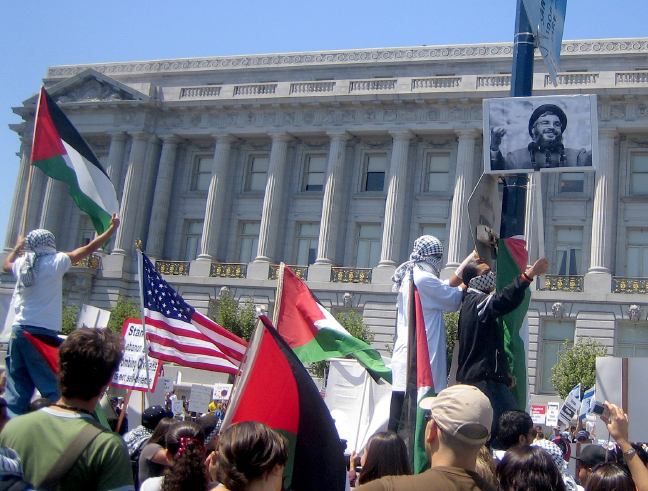
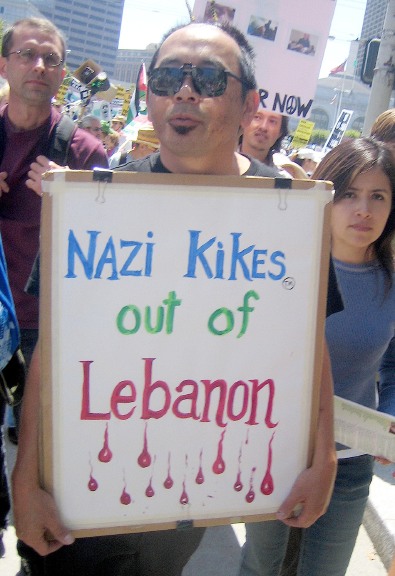
I stumbled upon some photos from a "Stop the US-Israeli War" rally in San Francisco. Funny. . . I wasn't aware that the US was at war with Israel. I guess I don't watch enough TV.

Anyway, I thought I'd post a few here so everyone can see how messed up America is.


I think this woman is part of the "Chicks for Hezballah" crowd. I dare her to walk down any street in Iran while wearing that outfit. Such an experience would be a reality check that might serve to temper her enthusiasm for the evil mullahs. She probably thinks "getting stoned" in Iran has the same meaning as "getting stoned" in SF.


This guy has what's known as a self-esteem problem.


These guys in blue are what pass for "security" in SF, and they're also known as SF's finest. Nothing much was going on at their local Starbucks, so they decided to wander on down to watch Nasrallah's supporters.


Here's Nasrallah now, making his way through the crowd of his adoring fans.


Nasrallah takes up residence on a sign post in front of SF City Hall. He'd probably be a very successful candidate for mayor. Not only that, he could bomb all those nasty people to the south, in San Mateo County.


As you can clearly see from the sign, there are illiterate women in America too. Obviously she can't read or she wouldn't be caught dead in public with a spelling faux pas like this one. The person who wrote the sign for her must have purposely misspelled "coup d'etat" as a practical joke, kind of like taping a "Kick Me" sign on someone's back and snickering about it.

As for what the sign actually means, I have no idea. "Fan Flames?" "Christian Fundamentalists?" Go figure.


For those who don't know, "kike" is like "çıfıt" in Turkish. I wonder how this guy would feel if someone walked around with a sign that read: "Nazi Chinks Out of US?"


I saved my favorite for last--the HAMAS flag in front of City Hall. Somehow, it seems appropriate in light of the fact that all the Lunatic Fringers are pacifists who pretend that they love everybody.

Kind of odd, isn't it, that in this protest, there was no mention of the occupation of Kurdistan? I guess that's because the only people in attendance were the supporters of the enemies of Kurdistan.


THIS JUST IN . . . Ahmedinutjob has started his own blog. American newsman, Mike Wallace, recently interviewed Iran's head squirrel and characterized him as "smart as hell."

However, Ahmedinutjob, admits that he had to have adult help to read newspapers while in the first grade. Obviously, then, he's not so smart. I read newspapers in the first grade without adult help, even reading them and to my mom as she made dinner.

He's not quite as "smart as hell," is he? I think Alzheimer's is setting in with old Mike.

SHAYS' REBELLION AND SOUTH KURDISTAN


"I hold it that a little rebellion now and then is a good thing, and as necessary in the political world as storms in the physical."
~ Thomas Jefferson.


The Thomas Jefferson quote today is in reference to Shays' Rebellion. Never heard of Shays' Rebellion? Back in 1786, a serhildan arose in western Massachusetts, led by a former Revolutionary War captain named Daniel Shays. Shays' followers were the small farmers from that rural area, and they were angered by the heavy taxes laid on the people as a result of the debt incurred by the Revolutionary War. This resulted in a heavy financial burden on the farmers, many of whom fell into debt. If you fell into debt in those days, they put you in prison. Daniel Shays and his followers made serhildan because of this injustice. In addition, they demanded more democracy because it appeared to them that the young American government had become as much a tyrant as the British king had been.

Shays' serhildan was eventually defeated, but the curious thing about it was that there were very few casualties in this American serhildan. It was more of an armed political protest rather than a proper serhildan. The long-term effect of Shays' serhildan was a re-evaluation of the confederal government that the US had at the time. It was this re-evaluation which provided strength to the Constitutional Convention in 1787, a convention which eventually led to the creation of the US Constitution and its Bill of Rights.

Thomas Jefferson gave wholehearted support for the people's right to confront the government with their grievances--even when that confrontation became violent. This Founding Father was no politcally-correct, pussyfooting pacifist concerned more with politeness than justice. He was the ideological father of revolution. This guy had an attitude. So let's consider the recent unrest in South Kurdistan with Shays' Rebellion and Thomas Jefferson in mind. In particular, there's a World War 4 Report, which cites information from the Worker-Communist Party of Iraq and Radio Free Europe/Radio Liberty.

So far it looks like most of the trouble has been in the PUK area: Darbandixan, Çemçemal, Kefri, Kalar, and now Silêmanî, including the trouble at the Tasluja cement factory. However, the unrest may be spreading to the KDP areas as well.

What is the motivation behind the construction of huge resorts and one of the region's largest shopping malls? How are these things going to benefit the ordinary people? If they can barely earn enough to sustain themselves and their families, what good is a resort or mall to them? Then we have the stupid new investment law, in which foreign entitites are encouraged to come to South Kurdistan to "invest," while getting away without contributing anything to the Kurdish people through tax revenues. The markets in South Kurdistan are flooded with Turkish and Iranian products and we have no proof that any effort is being made toward the production of Kurdish goods. Kurdistan should be the bread basket of the region, but there is no incentive for agricultural production or processing.

I have no doubt that someone is benefitting, and benefitting immensely from all of this so-called investment, lack of incentive for Kurdish production, and extreme exploitation of the Kurdish worker. From the WW4 Report:


While demonstrators have attempted to hold the government accountable, some say there is little that can be done to effect change. As the two main ruling parties, the KDP and PUK solidified their hold on power during their 12 years of self-rule before the fall of the Hussein regime. In the post-Hussein era, officials tied to the parties have grown wealthier and in some cases, more flagrant in their abuse of power, critics charge.

[ . . . ]

The continued widespread perception among the public that officials care less about their needs and more about lining their own pockets with lucrative business deals and other profitable endeavors has only exacerbated the divide between the people and their representatives.

Moreover, it has fueled a growing perception that only those with close ties to the ruling parties will reap the benefits of a decent education or career advancement based on credentials, rather than connections. Such frustration, observers argue, could lead to a massive brain drain from the region.


The WW4 Report mentions examples of repression of the press, too, repression which sounds exactly like everything the neighbors do. Only television cameras from the two main parties are permitted to film demonstrations. Even an independent journalist caught filming a demonstration on his cell phone was arrested, something that should be a reminder of cameras having been confiscated from journalists immediately following the Helebçe uprising last March. The thugs of both the PUK and KDP are confiscating cameras of journalists, which leads me to believe that PUK is not alone in arresting journalists either. An even bigger double standard than fascist acts by the two ruling thugocracies that sing a democratic tune for foreigners, is the fact that Kurdish intellectuals and journalists have accepted large cash "gifts" to become propagandists for both parties' media.

Check what an Hawlatî editorial had to say about working conditions for some of the people:


Recent examples of editorials marking the pages of Iraqi newspapers include a July 26 editorial published in "Hawlati," which pleaded with the region's ministers to "just once" try working as a traffic policeman, whose commands go ignored by officials in new cars who hurl trash at the officers; or teach in a sweltering classroom where there are no supplies or electricity. Try giving a lecture "on the sixth floor of a building without lifts or power. After that, make some notes about the resilient teachers and their salaries," the author wrote, referring to recent demands by academic and medical unions for salary increases.


By the way, Hawlatî is not an Iraqi paper; it's a Kurdish paper.

Those few who do attempt to report reality are treated the same way that truth-speakers in Turkish-occupied and Iranian-occupied Kurdistan are treated. Can party-sponsored bombings of media offices and disappearances or extrajudicial murders of journalists and human rights workers be far behind? Exactly in the manner of their fascist Turkish "investment" partners to the north, the Southern Kurdish parties blame all the protests on the instigation of foreigners, saboteurs and rioters:


Local media have also been quick to criticize the government for regularly claiming that demonstrations are carried out by "foreigners" or "saboteurs and rioters," rather than admit that public dissatisfaction is running deep these days. One example of this was the two parties' reactions to demonstrations that erupted in Halabjah this spring, which they blamed on foreigners. Dozens of protesters and members of the media were arrested.


Is it too early to refer to PUK/KDP rule as a thugocracy?

The two Southern Kurdish parties are extremely adept at providing not only for the basic needs of themselves, but also for their cronies and clients. As a result, it looks to me like it's a good day for a Kurdish Shays' serhildan. One way to help is to send letters of protest to the KDP and PUK offices, in solidarity with the call from the Worker-Communist Party of Iraq. Contact information for the US:


PUK:

1634 Eye Street, N.W. Suite 210
Washington, D.C., 20006

Tel: +1-202-637 2496
Fax: +1-202-637 2723
Email: PUKUSA@PUK.ORG

KDP:

7115 Leesburg Pike # 110 A
Falls Church VA. 22043

Tel. + 703 - 533- 5882
+ 703 - 533- 5884
+703 - 533- 5886
E-mail: pdk7usa@aol.com


RSF has a report on a Kurdish journalist murdered by the evil Iranian mullahtocracy. In a tactic that sounds suspiciously familiar from the death of PJAK şehîd Dilxwaz, Ayfer Serçe's body is held by the regime.

Another item of note from the Let's-Screw-the-People Department concerns one of the largest recruiters for interpreters in South Kurdistan and Iraq: Titan Corporation. If you're one of Titan's interpreters, you better be prepared to do US military combat and intelligence operations, and when things go south in a big way, you better be prepared to be screwed:


Goran Habbeb had just left his house to get into his car with his brother and his 7-year-old daughter, Soleen, when the armed men opened fire. Taken by surprise because the men were dressed in police uniforms, he just managed to get the white Toyota Previa van into motion and escape.

Habbeb was planning to drop his daughter off at school before going to work at a U.S. Army base in the northern Iraqi city of Kirkuk. An Iraqi national, he worked as a "linguist" for Titan, a San Diego-based military contractor employing thousands of translators across Iraq under a multi-billion-dollar contract.

Habbeb's relief lasted only a few minutes. He dropped his brother off and then the nightmare began. Two cars pulled alongside him and opened fire again. He pulled out his pistol and fired back while trying to push his daughter out of the direct line of fire. She received three bullets and he took seven, including one that damaged his spine.

[ . . . ]

Many of Habbeb's fellow Titan employees have fared far worse. A total of 199 Titan translators have been killed in Iraq and another 491 have been injured, according to U.S. Department of Labor statistics – the highest of any company in Iraq.

[ . . . ]

A San Diego Union-Tribune reporter puts the blame for the high death rate on both the company and the government: "Employees of Titan and other corporations have become part of an experiment in government contracting run largely by trial and error."


More at CorpWatch.

What can you expect if you're one of Titan's non-American interpreters? You can expect to get paid much less than American citizens for much more dangerous work, to not get proper medical treatment, and to be left handicapped and in harms way--including the endangerment of your family. For more on getting screwed, check out what happened to another of Titan's interpreters, an Iraqi-born American from San Diego.

In addition to translation services, Titan also has its fingers in spy plane development, war game development, full-service support "for Chemical, Biological, Radiological, Nuclear, and High-Yield Explosive (CBRNE) Consequence Management operations," and support for the DHS's national security preparedness exercises. See SourceWatch for more.

It's so comforting to know that a company that has pled guilty to bribery of foreign governments is heavily involved in US national security. I know that this knowledge certainly makes me sleep better at night.

Thursday, August 10, 2006

WHOSE BLOOD IS REDDER?


"The events are under control... Security forces will intervene with every possible means indiscriminately, including against women and children."

~ R. Tayyip Erdogan.


I noticed something odd about TDN on Tuesday of this week, but haven't had the chance to comment until now. On Tuesday, TDN ran three articles on anti-semitism in Turkey. Of course, they're claiming it isn't anti-semitism at all, but merely a little disagreement over Israel's approach to Hezbollah that has people protesting.

The headline of the first article reads, "Anti-Israeli wave fed by policies, not anti-Semitism." Thousands are taking to the streets almost daily to protest Israel's actions against Lebanon, we are told, but this is simply a matter of the dislike that Turks have for Israeli policies, officials pontificate. No mention is made of the Iranian army (Hezbollah) lobbing missiles and rockets into Israel because Turks don't object to that. Nor do they object to Iran's policy of annihilation of Israel.

Most of the deputies of the Ankara regime's parliament have been dropping like flies out of their Turkish-Israeli friendship club, with one former member saying that if Israel changes its policies, he may consider rejoining.

Also mentioned is the rumor that Buyukanit Pasha is a Jew.

Buried in the middle of all this nonsense, TDN tell us the real reason everyone's so touchy about being labeled anti-semitic. An influential weekly with a world-wide reach, The Economist, made some comments in its recent issue about the rising "anti-Semitic wave" in Turkey.

Better late than never, I guess.

Last year, in March, Hitler's Mein Kampf was selling like hotcakes all over Turkey. I saw it myself in a fancy grocery store in Amed, built to service the anti-semitic families of the anti-semitic TSK. Saw it in Istanbul, too. If you google the terms "mein kampf turkey," you get a bunch of returns about this news. One of the most interesting was from WorldNetDaily:


While most Turkish publishers of 'Mein Kampf' say they are merely pursuing the profit motive, others admit that anti-Semitic and anti-American feelings are fueling demand.

Sami Kilic, owner of the Emre publishing house, has sold 26,000 copies of the book from a printing of 31,000 in January. "Mostly young people" are reading it, he says.

[ . . . ]

"This book, which does not contain a single ounce of humanity, unfortunately appears to be taken seriously in this country," political scientist Dogu Ergil recently told a newspaper interviewer. "Nazism, buried in the dustbin of history in Europe, is beginning to re-emerge in Turkey," he warned.


The WorldNetDaily article notes that Mein Kampf was selling for almost five dollars a copy, as compared to the usual fifteen dollars for most books. How much does anyone want to bet the Gray Wolves are subsidizing the publishing of the bible of fascism?

The MHP (Gray Wolves/ulkuculer), was founded by an admirer of Adolf Hitler, Alparslan Turkes. Back in the year 2000, while Europe was pitching a bitch because the Austrian government formed a coalition with an extreme right-wing, pro-Nazi party (anyone remember Jorg Haider?), Europe also granted candidate status to Turkey. At the time, the second largest political party in Turkey was the MHP, and no one in the EU batted an eyelash at that fact. The MHP had murdered thousands of people in Turkey during the 1970s, attempted to murder the Pope, and is deeply involved in the deep shit of the Deep State.

MHP is intricately connected to the Turkish-Islamic synthesis. As Alparslan Turkes himself stated (p. 14):


‘Islam is a source that keeps the nation together and provides spiritual and moral discipline. Thus, Turkish nationalism is not based on a conflict between Islam and ethnic-nationalism, rather it includes a historical [preordained], synthesis of Islamic and Turkish ethnic values.’


A second TDN article in the same vein is here.

TDN's editorialist, Yusuf Kanli gets into the act:


Do we really have such anti-Semitism and anti-Americanism in Turkey? Or are we just witnessing increased public anger towards the methods of state terrorism and undeclared war that Israel has unleashed on Lebanon and the efforts by the George W. Bush administration of the United States to stall all calls for a cease-fire, thus providing more time for the Israelis to finish off what they started?


Turkish intellectuals get into the act:


In one of the most strongly worded condemnations of Israel's attacks on Lebanon and Palestine coming out of Turkey, seven of the country's leading intellectuals have united to issue a public declaration charging the leaders of Israel, the United States and Britain of "committing crimes against humanity".

[ . . . ]

Stating that the USA, Britain and Israel were responsible for "imperialist, colonialist and aggressive policies" the declaration said its leaders had collectively committed offences ranging from mass destruction warfare to premeditated massacre, the deliberate killing of children and civilians.


By now the stench of hypocrisy should be making your eyes water.

Where were all the "officials," TDN, Yusuf Kanli, the Turkish intellectual class, and the thousands of protestors when the babykillers of the Turkish security forces were shooting Kurdish babies in Amed? Why have they not condemned the babykillers of the Turkish security forces for their slaughter of 40,000 Kurds from 1984 to 1999? Why have they forgotten that the grandfathers of the babykillers in the TSK murdered 40,000 Kurds in Dersim in 1937? Why don't they protest American arms sales to their own babykillers in the Turkish security forces? Why don't they protest that the US and EU support the babykillers of the Turkish security forces? Why have these people never sent humanitarian aid to the Kurds of Turkish-occupied Kurdistan?

Not one of these people have ever protested Turkish atrocities against Kurds. Ever. Ask yourself this: If it were Syria attacking Lebanon and killing civilians or using civilians as human shields, would we see such frenzied activity on the part of the Turkish media or citizenry? When we see Iran launch its first nuke, will we see Turkish protests? Will the Turkish media step all over itself to make a stink about it?

Don't hold your breath.

Clearly then, neither the issue of murder nor that of fascist atrocities is the concern of any of these people either. Neither TDN's protests nor those on the street have anything to do with human rights abuses or the horrors of war. Nor are these protests the result of any kind of generalized pacifist political movement.

To paraphrase Bill Clinton's 1992 campaign slogan: It's The Economist, stupid.

Wednesday, August 09, 2006

TURNING UP THE HEAT

The heat is on, on the street
Inside your head, on every beat
And the beat's so loud, deep inside
The pressure's high, just to stay alive
'Cause the heat is on
~ Glenn Frey.


It seems like Teyrêbazên Azadiya Kurdistan (TAK) has been seriously turning up the heat in recent days.

Stratfor has a write up on recent events, especially an attack in Adana on 4 August:


The first bomb, the smaller of the two, exploded at a bank in downtown Adana, injuring two bank security guards. About 10 minutes later, a second, larger device detonated at a nearby construction site, damaging nearby shops and police cars, and injuring at least five police officers. It appears the attackers detonated the smaller device with the intention of drawing Turkish police and security forces into the area, and then set off the second explosion to take out these first responders. No group has yet claimed responsibility for the explosions, but Turkey has often been the scene of bomb attacks attributed to left-wing groups, Islamist militants and Kurdish separatists.


In the meantime, someone has claimed responsibility, and it's TAK:


NEWSDESK, Aug 8 (DozaMe.org) - A lure-and-kill-trap attack by the Kurdish militant organization TAK (Kurdistan Freedom Falcons) in the city of Adana in southern Turkey left 18 people wounded, among them 12 police officers.


The target was an OYAK Bank, which is run by the Turkish military. A report from last year indicates that OYAK would like to diversify, while some of us would just like to see them put out of business. The most significant aspect of the TAK attack is that it used two bombs, as DozaMe and Stratfor describe. By the way, TAK's statement is carried at the TAK link, above.

This attack, along with five others in two days time at the end of July, it certainly looks like they aim to escalate. Check DozaMe and KurdishInfo for more.

In other news, HPG carried out a successful attack against a Turkish military intelligence (JITEM) non-commissioned officer, in Şirnex province of Turkish-occupied Kurdistan. You gotta love Şirnex; it's a veritable hotbed of Kurdish patriots. It's great to know that the chief of the local JITEM rathole is pushing up daisies these days.

Activity is picking up in Iran too. I guess the evil mullahs are none too happy about Kurds in pasdaran forces slitting Iranian throats and then making the defection to HPG. That's why they're now offering rewards for every dead gerîla that's brought in. When the evil mullahs realize that the virgin thing isn't cutting it and they start offering money, you know they're desperate.

Turkey shares that desperation, from the Stratfor link:


Despite increased fighting between Turkish troops and Kurdish militants in eastern Turkey, the militants still have been able to carry out -- and even escalate -- attacks. Ankara, which understands the tourism industry's importance to the country's economy, likely is sparing no effort to prevent attacks and eliminate the TAK threat. Thus far, however, the Turkish National Police and intelligence agencies have been unable to do either. With little to stop it, the TAK can be expected to escalate its campaign against Ankara.


I had to point out all this activity because, in yesterday's post, the GIS/D&FA source noted the following:


In any event, PKK forces are reportedly well aware of the pace of Turkish invasion planning and report themselves to be ready for the confrontation.


A few weeks ago, on 21 July, HPG issued a statement which included the following:


The HPG (People’s Defence Forces) Headquarters Commander Dr. Bahoz Erdal said that the Turkish military and the AKP (Justice and Development Party) government was responsible for the escalation of conflict, stating, “if they become insistent on violence and non-resolution then the guerilla will extend to the Mediterranean and Aegean.”


Both TAK and HPG are turning up the heat, kicking it up a notch, upping the ante, and it looks like HPG is sending the message that it's capable of urban operations in the Meditarranean and Aegean. None of this has to be because there is one simple way to solve it all: Occupying forces out of Kurdistan.

To say that the natives are pissed off and restless, is an understatement. However, given the events in the last couple of weeks, at least they're smiling.